3I/ATLAS Has Begun Shaking Violently, Then THIS Happened…
An Interstellar Mystery Awakens
For months, astronomers observing the interstellar object 3I/ATLAS had cataloged an increasingly bizarre array of anomalies. Unexplained accelerations, non-gravitational motion, coherent jets, and a rotational stability that defied all expectations hinted that this was no ordinary object from beyond the solar system.
But nothing could have prepared researchers for what came next.
Short, rhythmic tremors began coursing through the object’s surface — not random fractures, not thermal cracking, not the uneven stress patterns typical of space rocks. These were precisely timed pulses, repeating every 147 seconds. Simultaneously, radio telescopes detected low-frequency electromagnetic bursts synchronized perfectly with the tremors. The metronomic regularity was unlike anything observed in a natural celestial body.
The First Signs: Metronomic Internal Tremors
The initial clue emerged as subtle fluctuations in the object’s brightness. Once corrected for rotation and viewing angles, the variations revealed a consistent, repeating pattern.
Spectral analysis confirmed the presence of internal tremors, pressure waves moving beneath the outer crust. Unlike ordinary thermal or stress fractures, these tremors:




-
Repeated exactly every 147 seconds
-
Spread uniformly across the object
-
Intensified over time
-
Showed no correlation with external heating
-
Left rotation unaffected
Where natural interstellar objects wobble, shift, or shed mass under stress, 3I/ATLAS remained perfectly balanced, spinning with the precision of a “balanced bullet,” as one astronomer noted.
Radio Pulses: A Signal Beyond Nature
As tremors intensified, a far more remarkable phenomenon appeared: low-band electromagnetic pulses repeating in perfect sync with the 147-second cycle.
The pulses:
-
Maintained constant intensity
-
Remained fully synchronized
-
Originated from the direction of 3I/ATLAS
-
Exhibited hints of mathematical structure, including prime number intervals and Fibonacci-like modulation
Even more astonishing: the source region of these pulses aligned closely with the 1977 “Wow!” Signal, the most famous unexplained radio burst ever detected. Whether coincidence or not, the alignment added a chilling layer to the mystery.
Rotation Too Perfect for Nature
Despite violent internal tremors, 3I/ATLAS maintained an uncannily stable rotation. Its spin displayed:
-
No wobble
-
No tilt
-
Perfect torque balance
-
Near-flat brightness variation
This stability defied all natural expectations. Objects under internal stress typically lose rotational balance; 3I/ATLAS remained controlled, as if stabilized intentionally. Avi Loeb, an expert on interstellar anomalies, remarked that this “resembles controlled stabilization rather than natural balance.”
Shaking Alters Its Trajectory
Even stranger, the internal tremors began producing directional nudges, subtly shifting the object’s trajectory toward the inner solar system. These nudges:
-
Were consistent and cumulative
-
Occurred in the same direction each time
-
Synchronised with the 147-second pulse
The tremors effectively acted like micro-propulsive events, guiding the object along a patterned path. No known natural process could produce such coordinated, internally generated trajectory adjustments.

Internal Layers and Surface Light Waves
High-resolution imaging revealed internal layers pulling apart from within, forming smooth arcs in perfect time with the 147-second tremor cycle. Unlike thermal cracking, which begins at the surface, 3I/ATLAS fractured from the inside out, suggesting either controlled expansion, compartmentalized pressure, or a timed internal mechanism.
Simultaneously, faint waves of light traveled across the surface, synchronized with tremors. These waves:
-
Moved in coherent arcs
-
Increased in brightness with stronger tremors
-
Disappeared when the pulse dropped
Natural comets do not transmit light in such a controlled, rhythmic fashion. This appeared to be active signaling, not passive reflection.
Dust Trails Respond to Internal Signals
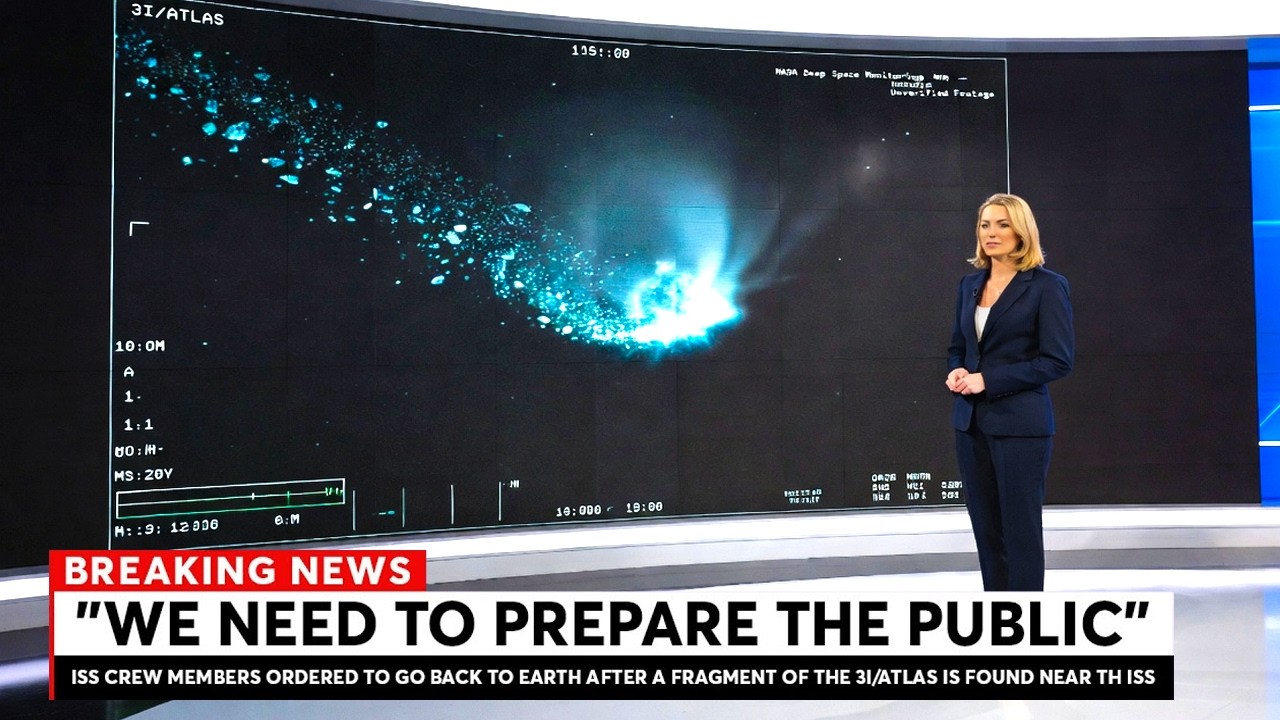
The final anomaly stunned astronomers: the dust trail behind 3I/ATLAS began bending in rhythmic arcs, pulsing in perfect alignment with the internal tremors.
-
The arcs moved in layered waves
-
Defied expected solar-wind patterns
-
Responded directly to the internal 147-second cycle
Even minor rotation instability would have disrupted these patterns. Yet, 3I/ATLAS remained stable, actively influencing the surrounding debris.
Conclusion: A System, Not a Rock
When all anomalies are combined, a disturbing picture emerges:
-
Internal tremors
-
Perfectly stable rotation
-
Synchronized radio pulses
-
Timed brightness oscillations
-
Internal layer separation
-
Coherent light waves
-
Dust reacting in rhythmic arcs
-
Directional trajectory changes
Each feature alone might be dismissed. Together, they form a coordinated, structured sequence — a behavior unlike any known natural object.
While scientists have not publicly declared 3I/ATLAS artificial, many privately admit its behavior is no longer consistent with a simple comet or asteroid. It is acting as an active system, responding internally and externally, as if preparing for something beyond current comprehension.
The 147-second pulse continues. The tremors intensify. The trajectory bends steadily inward. And through it all, 3I/ATLAS spins with unnerving precision, a silent herald of mysteries yet to unfold.
