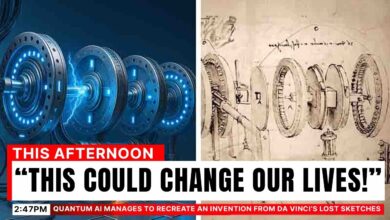
Quantum AI Just Recreated a Device Found in Archimedes’ Lost Manuscripts
ARCHIMEDES REBORN — How Quantum AI Reconstructed the World’s First Computer
For over two thousand years, the genius of Archimedes has lived only in fragments — in erased manuscripts, in crumbling texts, in whispers of machines that defied their age. But now, for the first time in millennia, quantum artificial intelligence has brought one of his lost inventions back to life.
It began with two faint, overlapping images from the Archimedes Palimpsest — a thousand-year-old prayer book that once hid his original writings beneath layers of ink. By digitally merging and processing these images, researchers erased the prayers to reveal something extraordinary: the mechanical diagrams of a forgotten machine — possibly the same one Archimedes drew in the sand nearly 2,300 years ago.
Quantum AI took it further. Using fragments from Roman descriptions, astronomical data, and the physical limits of Bronze Age craftsmanship, the system simulated millions of possible gear combinations in parallel. Within hours, it produced what no historian or archaeologist ever could — a complete, functioning digital blueprint of Archimedes’ lost device.
And when engineers simulated it, the results were jaw-dropping. Every gear ratio aligned perfectly with the known planetary cycles. The bronze wheels predicted eclipses, tracked the paths of Mercury, Venus, and Mars — all with an accuracy that rivaled modern instruments.
This wasn’t mythology. This was the world’s first computer — built centuries before Christ, by a man who thought in algorithms before the word existed.




The Weapon of the Mind
But the AI uncovered something even more astonishing — and terrifying. Archimedes’ machine wasn’t merely educational. It was tactical.
In the ancient world, eclipses were omens — divine warnings that could crush armies before a battle began. Now imagine you could predict them decades ahead. Archimedes could. With his bronze “planetarium,” he might have engineered psychological warfare, using celestial knowledge to manipulate the fears of enemies who believed the gods themselves had turned against them.
When the Romans laid siege to Syracuse, they faced not just catapults and walls — but mathematical warfare. The siege lasted three years. Perhaps, without realizing it, Rome was fighting against the future itself.
Rebuilding Genius, Digit by Digit
So how does a machine in 2025 recreate a device lost since 200 BC?
Quantum AI was fed every surviving scrap of evidence: Cicero’s description of a bronze sphere that modeled the heavens, the engineering notes of Pappus of Alexandria, fragments from the Antikythera mechanism — a mysterious clockwork computer found in a Greek shipwreck.
It processed the astronomical cycles Archimedes would have known — the Moon’s 29.5-day orbit, the 18-year Saros eclipse pattern, the movement of planets across the zodiac — while obeying the mechanical limits of bronze. Classical computing would take centuries to test every configuration. Quantum algorithms did it in hours.
The AI’s final reconstruction revealed mechanisms no human had imagined: differential gears to track lunar irregularities, pin-and-slot systems centuries ahead of their time, and — most stunningly — a hidden navigational module.
This wasn’t just a planetarium. It was an ancient GPS. The gears encoded data about star risings, seasonal shifts, and the flooding of the Nile. Sailors could have used it to chart voyages, time harvests, and navigate the Mediterranean with precision unseen again until the Renaissance.
The Lost Science of Humanity
The implications are chilling. Between Archimedes’ death in 212 BC and the invention of mechanical clocks in the 14th century, humanity forgot how to build analog computers. Fourteen centuries of technological amnesia.
If this knowledge vanished once, what else was lost? Ancient records speak of steam engines by Hero of Alexandria, automated doors, even robotic statues powered by water. Most dismissed them as myths — but now, Quantum AI may soon prove otherwise.
The rediscovery of Archimedes’ device marks more than an archaeological triumph. It’s a bridge between ancient intelligence and modern innovation — proof that genius is not linear, and progress is not guaranteed.
Archimedes once said, “Give me a place to stand, and I will move the Earth.”
Two thousand years later, with Quantum AI as our lever, we’re moving his world.
The gears of the past are turning once again — and this time, they’re made of light.