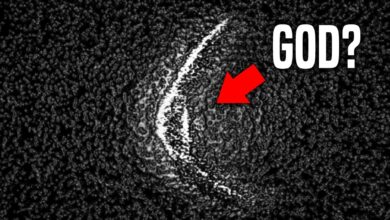
3I/ATLAS Ignites Just After Massive Impact, Space Telescopes Capture Brightest Surge Ever
The James Webb Space Telescope first caught sight of something unusual — a massive object silently cutting through the black sea of space, heading in our direction. In the blink of cosmic time, the universe stirred. An event of staggering power ignited across the heavens, leaving astronomers breathless. The interstellar visitor known as Three-Eye Atlas had awakened. Its flare — a sudden, impossible bloom of light — was so intense that even the most seasoned scientists were left stunned.
For a moment, the cosmos seemed to hold its breath.
Was this a reflection of sunlight glancing off a solid, alien surface? Or the shimmering glow of a dense dust cloud erupting from within? Whatever it was, the surge that followed registered as the brightest luminosity ever recorded by human instruments — a flash so fierce it outshone entire galaxies for a heartbeat.
A Visitor Not Bound by the Sun
Three-Eye Atlas wasn’t an ordinary comet. It was first detected by NASA’s Asteroid Terrestrial-impact Last Alert System (ATLAS) — a sky-scanning network designed to detect near-Earth threats. At first, it appeared as nothing more than a faint glimmer. But its trajectory told another story. Unlike normal comets locked into elliptical orbits around our sun, Three-Eye Atlas was moving on a hyperbolic path, a cosmic flyby — a visitor from another star system, never to return.
Its velocity was mind-bending — over 152,000 miles per hour relative to the sun. At that speed, it could circle Earth six times in a single minute. No natural comet had ever moved so fast, or so precisely.
But it was when Atlas neared the sun that the spectacle truly began. Solar radiation began vaporizing the frozen gases on its surface — a process called sublimation. Normally, this creates the glowing tail we associate with comets. Yet Atlas didn’t behave like any comet ever seen. Instead of slowly brightening, it erupted — a blinding surge of emerald light that spanned thousands of miles. Telescopes from around the world captured its transformation, as if something deep inside the comet had ignited.




A Flare Unlike Any Other
The James Webb Space Telescope, peering through its infrared lenses, revealed what looked like a burst from within — not just sunlight reflecting off ice, but a pulse of energy radiating outward. The composition data was the real shocker: Atlas contained elements familiar to our solar system — carbon, nickel, cobalt — and yet arranged in ways that suggested something far stranger.
Hubble and Gemini South followed, revealing a magnificent green halo — a living jewel of space — surrounded by a symmetrical tail unlike any comet’s plume. It wasn’t just bright; it was alive, flickering with rhythm, as though powered by some hidden mechanism.
Scientists scrambled to explain it. Could this be evidence of universal comet chemistry — that star systems across galaxies form similar icy wanderers? Or was this something artificial — a machine feeding on sunlight?
A Cosmic Key from Another Star
Three-Eye Atlas offered something priceless: a chance to study untouched material from beyond our solar system. It carried dust, gas, and ices from another sun, another time — perhaps even another kind of planet. Every sample of light it gave up told a story of how other worlds might form, evolve, or die.
Its nucleus — several miles wide — dwarfed the first known interstellar visitor, ‘Oumuamua. That sheer size alone explained some of its brilliance, but not all. The data suggested internal activity — possibly magnetic, possibly even technological.
The Atlas system had found a jewel, and scientists knew it. What began as a planetary defense project now uncovered one of the most enigmatic cosmic visitors in recorded history. Its discovery on July 1, 2025, was just the beginning. Ongoing observations through the end of the year promised answers — or perhaps deeper mysteries.
But Atlas wasn’t the only source of cosmic light turning night into day. Across the universe, even greater surges — unimaginably bright, incomprehensibly powerful — shape the stars themselves.
When Dead Stars Collide: The True Brightest Surges
While Three-Eye Atlas set telescopes ablaze with curiosity, the true titans of cosmic brightness are kilonovae and gamma-ray bursts — events born from death itself. These are the collisions of neutron stars or black holes, the dense remnants of massive suns. A neutron star packs more mass than our sun into a sphere the size of a city. One teaspoon of its material weighs billions of tons.
When two neutron stars spiral together, they unleash a gamma-ray burst (GRB) so powerful it can outshine entire galaxies. For a few seconds, it releases more energy than our sun will emit in its entire ten-billion-year life. The aftermath — a kilonova — glows a thousand times brighter than a classical nova, as the debris forges gold, platinum, and uranium in the crucible of creation.
That’s right — the gold in your jewelry may have been born in the violent embrace of colliding dead stars.
In 2017, scientists witnessed one firsthand. Known as GW170817, it combined gravitational waves, gamma rays, and visible light in a single breathtaking event. For the first time, humanity watched the universe forge heavy elements — the raw materials of planets and life itself.
Repeating Cosmic Fireworks: The Mystery Deepens
And yet, even these known cataclysms don’t explain everything. Recently, astronomers detected a repeating gamma-ray burst, GRB 250702B — something that should be impossible. Such explosions destroy their source, yet this one pulsed again and again. The culprit may be a magnetar, a neutron star with a magnetic field a trillion times stronger than Earth’s. These stellar monsters act like cosmic lighthouses, sweeping space with bursts of radiation.
If so, we may be witnessing a new kind of stellar evolution — neutron stars that refuse to die quietly, instead erupting over and over like a heartbeat from beyond.
The Unseen Universe
Every telescope — from the James Webb to Fermi and Swift — forms part of a cosmic nervous system, watching for these flares of creation and destruction. Yet for all our technology, we still see only a fraction of what unfolds in the dark. Countless surges, impacts, and awakenings go unnoticed, hidden by dust, distance, or time.
Three-Eye Atlas reminds us that the universe is not silent. It’s alive — shifting, burning, evolving — and sometimes, it sends us a signal. Whether a comet from another star or a machine feeding on sunlight, it tells us this:
We are witnesses in a living cosmos.
Every burst of light is a heartbeat of the universe — and somewhere out there, the next one is already on its way.